
ERAA 2025 Edition
Key takeaways
ERAA 2025 shows that significant volumes of fossil‑fuelled capacity are likely to become economically non‑viable over the coming decade, as revenues in the energy‑only market are insufficient to sustain parts of the existing fleet. Action is therefore needed to maintain the security of electricity supply in Europe.
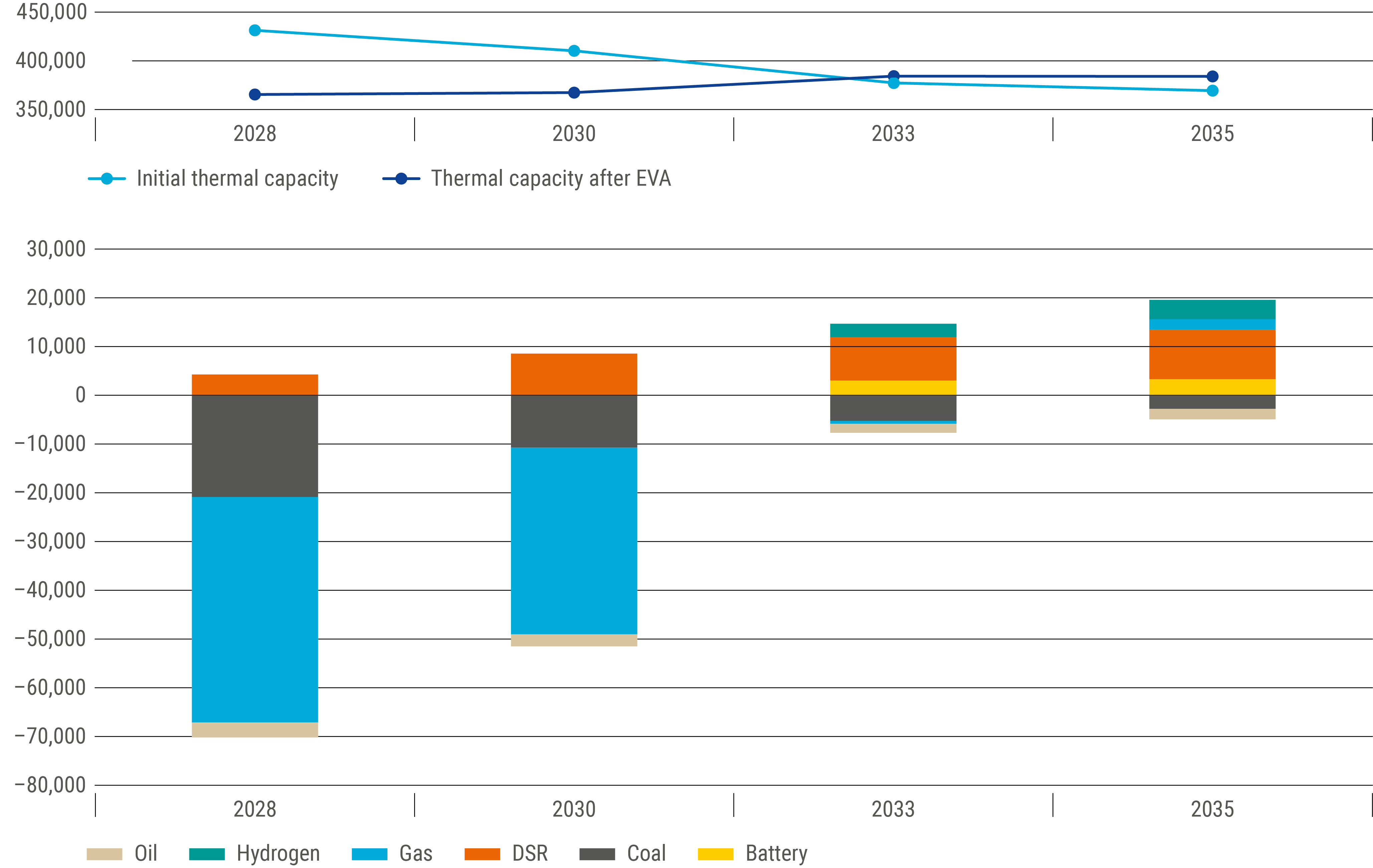
In the short- and mid-term (2028 and 2030) significant capacities are at risk of being decommissioned. In the longer term (2033 and 2035), the risks of decommissioning remain for thermal generation with only some potential gas investments in 2035. ERAA identifies some DSR expansion potential across Europe. However, these investments would require a favourable context beyond the scope of the ERAA, such as supply chain considerations, energy transmission networks and primary energy availability.
The development of the power system must be closely monitored to confirm that investments will be realised. Investment strategies have a huge impact on resource adequacy. Relevant authorities can reflect on possible mitigation actions to secure European adequacy. The equivalent should be monitored for existing power plants to ensure that the decommissioning of the current fleet will not exceed the anticipated levels. Renewable generation capacity is expected to expand over the coming years based on national policy targets and TSO estimates (Figure 2). However, due to the intermittency of renewable resources, the capacity will not be sufficient to compensate for the expected decline in dispatchable thermal generation and the growing electrification by 2035.
Notable adequacy risks are observed across Europe. Available reliability standards (RSs) are exceeded widely. The results show adequacy risks generally increasing the further we look into the future. They tend to be lower in the Balkan region and part of Scandinavia. Existing non-market resources for mitigating adequacy risks, such as contracted strategic reserves, have already been accounted for in these assessments. The identified notable adequacy risks indicate the need for additional resources to remedy them.
At the European level, the adequacy risk from decommissioning thermal capacity due to economic unviability remains, despite ambitious policy targets to support renewable generation capacity, storage, and DSR expansion, and some additional investment opportunities identified in the EVA. In this context, the right incentives and/or targeted intervention, such as long-term market mechanisms, are essential to avoid adequacy risks by providing efficient price signals. These signals would trigger both the retention of existing capacity in the market and the timely deployment of new capacity in the right location.
Urgent action is needed: additional policy mechanisms must be promoted where necessary to enable the transition while maintaining system security until the aforementioned incentives and/or targeted interventions are established. To accelerate the implementation of CMs, in May 2025, the European Commission (EC) established a fast-track option under the Clean Industrial Deal State Aid Framework (CISAF). To ensure electricity security and meet climate objectives, Europe must accelerate the deployment of flexibility solutions and infrastructure, including a cross-border electricity transmission network to direct electricity from renewable sources where it is most needed, as well as storage and other sources of flexibility, while safeguarding security of supply at all times.
Many Member States complement the ERAA with an NRAA across Europe. NRAAs can provide a more detailed picture of a Member State’s adequacy concerns, taking into account specific characteristics of national systems that may not be reflected in ERAA outcomes given the enormous size and complexity of the EU power system and computational constraints. While the ERAA is one of the instruments used to inform EU Member States and National Regulatory Authorities (NRAs) about the level of security of supply and serves as the basis for decisions on different market design options by providing a comprehensive pan-European overview of capacity concerns, it is not the sole basis for identifying resource adequacy concerns. NRAAs are also essential, as they provide a complementary and more detailed picture of national specificities and local sensitivities. The ERAA and NRAAs should therefore be considered in conjunction.
Lastly, ENTSO‑E stresses that the primary purpose of ERAA goes far beyond serving as a mere tool for centralised decisions on CMs. ERAA supports policymakers in identifying adequacy concerns and building mid‑ and long‑term strategies, using pioneering methodologies and tools to analyse future adequacy with an unmatched combination of scope and detail. Therefore, ENTSO-E stresses the importance of refining credible reference scenarios in the ERAA, enhancing the complementarity of NRAAs, and respecting Member States’ national prerogatives to define policy options for calculating CM parameters. ENTSO-E has submitted a draft revised ERAA methodology to ACER for approval. The ERAA continues to serve as an effective tool for identifying system needs. Ongoing methodological innovation, refinement of its scope, pilot programmes, and stakeholder consultation will continuous to enhance the ERAA’s value.
Main findings
Economic Viability Assessment Findings
ERAA 2025’s Economic Viability Assessment (EVA) finds that substantial volumes of fossil‑fuelled generation across Europe are at risk of becoming economically unviable in the energy‑only market, even before reaching technical end of life.
![Figure 2: Anticipated wind and solar capacity evolution [MW]](/assets/graphics/uploads/eraa/anticipated-wind-and-solar-capacity-evolution-mw-.png "Figure 2: Anticipated wind and solar capacity evolution [MW]")
Using a cost‑minimising, system‑wide planning model, the EVA shows that, once capacities already backed by capacity mechanisms or policy support are excluded, substantial fossil-fuelled generation capacity is at risk of insufficient revenues to maintain viability in the energy-only market. The decrease in fossil-fuelled capacity within the system may be steeper than currently anticipated through 2033, while some DSR expansion is observed over the horizon, only 2035 shows local potential for gas-fuelled generation expansion, and the EVA identifies viable market opportunities for investments in emerging hydrogen-fuelled generation. Market opportunities for storage and DSR technology are assessed across all target years, but the post-EVA capacity graph suggests that viable market opportunities tend to remain strained overall in Europe. The development of the power system must therefore be closely monitored to confirm that investments will be realised, while existing power plants should also be monitored to ensure that the decommissioning of the current fleet will not exceed anticipated levels; in this context, the right incentives and/or targeted intervention, such as long-term market mechanisms, are essential to avoid adequacy risks by providing efficient price signals.
Adequacy Findings
The results of the EVA naturally have a significant impact on the adequacy assessment. Adequacy risks appear in several European countries and margins are tight, with risks generally increasing the further the assessment looks into the future. The uncertainty range around these risks reflects the impact of different investment strategies and investor risk‑aversion assumptions on the amount of market‑viable capacity.
The LOLE values are represented by circles, with a larger radius indicating a larger LOLE value. A study zone’s LOLE is calculated by averaging the Loss of Load Duration (LLD), i.e. hours with unserved energy, resulting from all simulated Monte Carlo years using the reference tool.
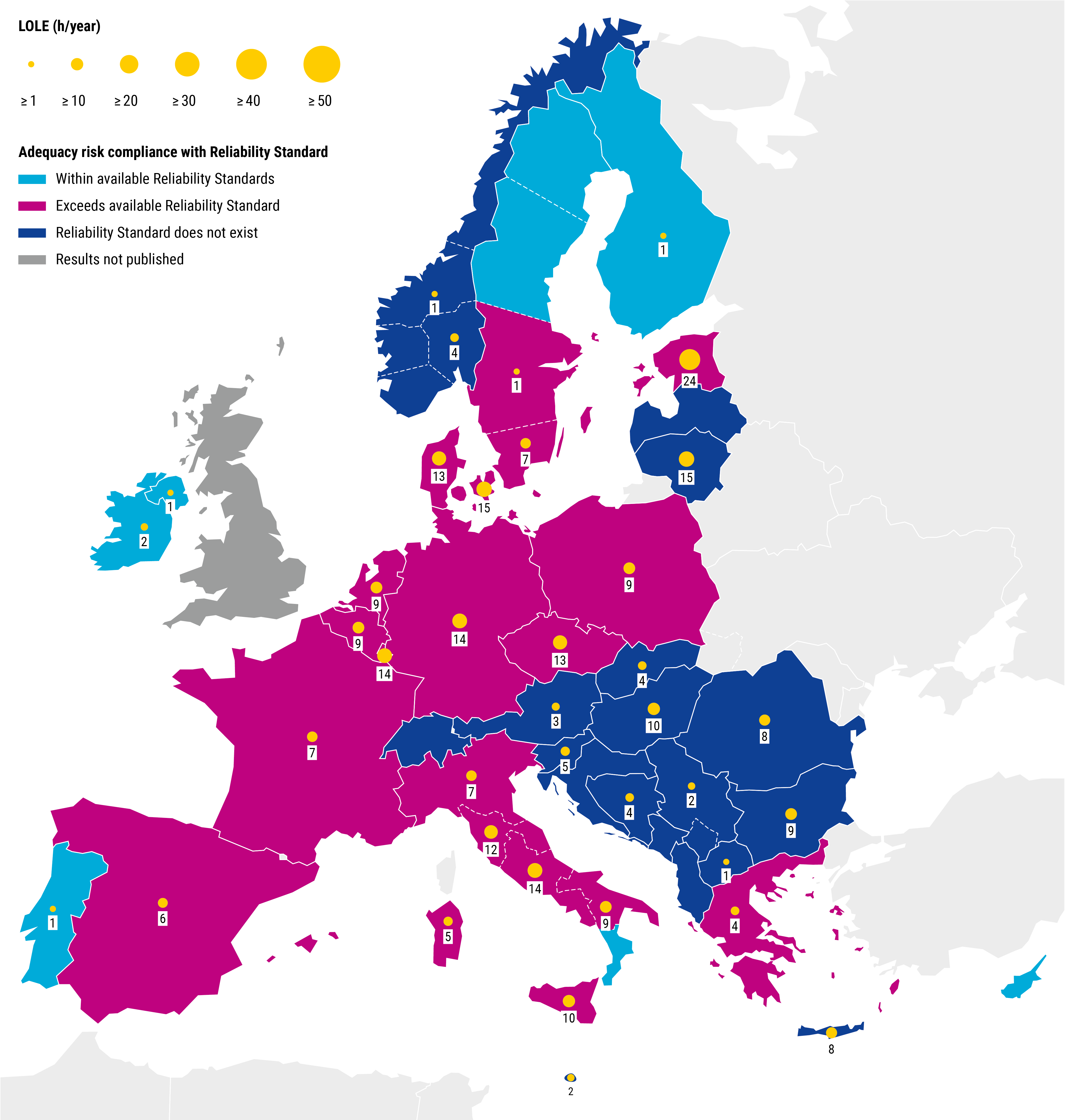
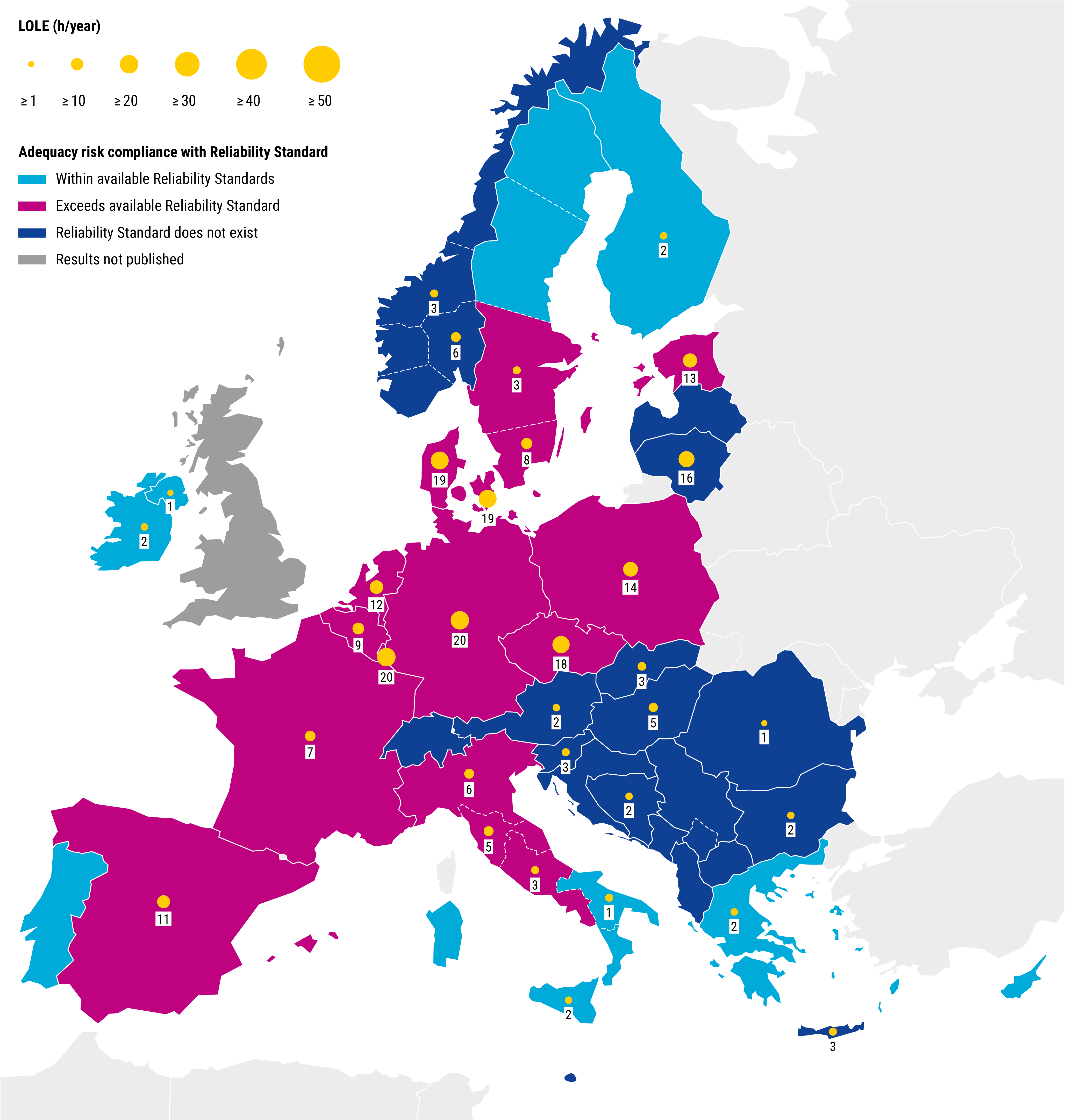
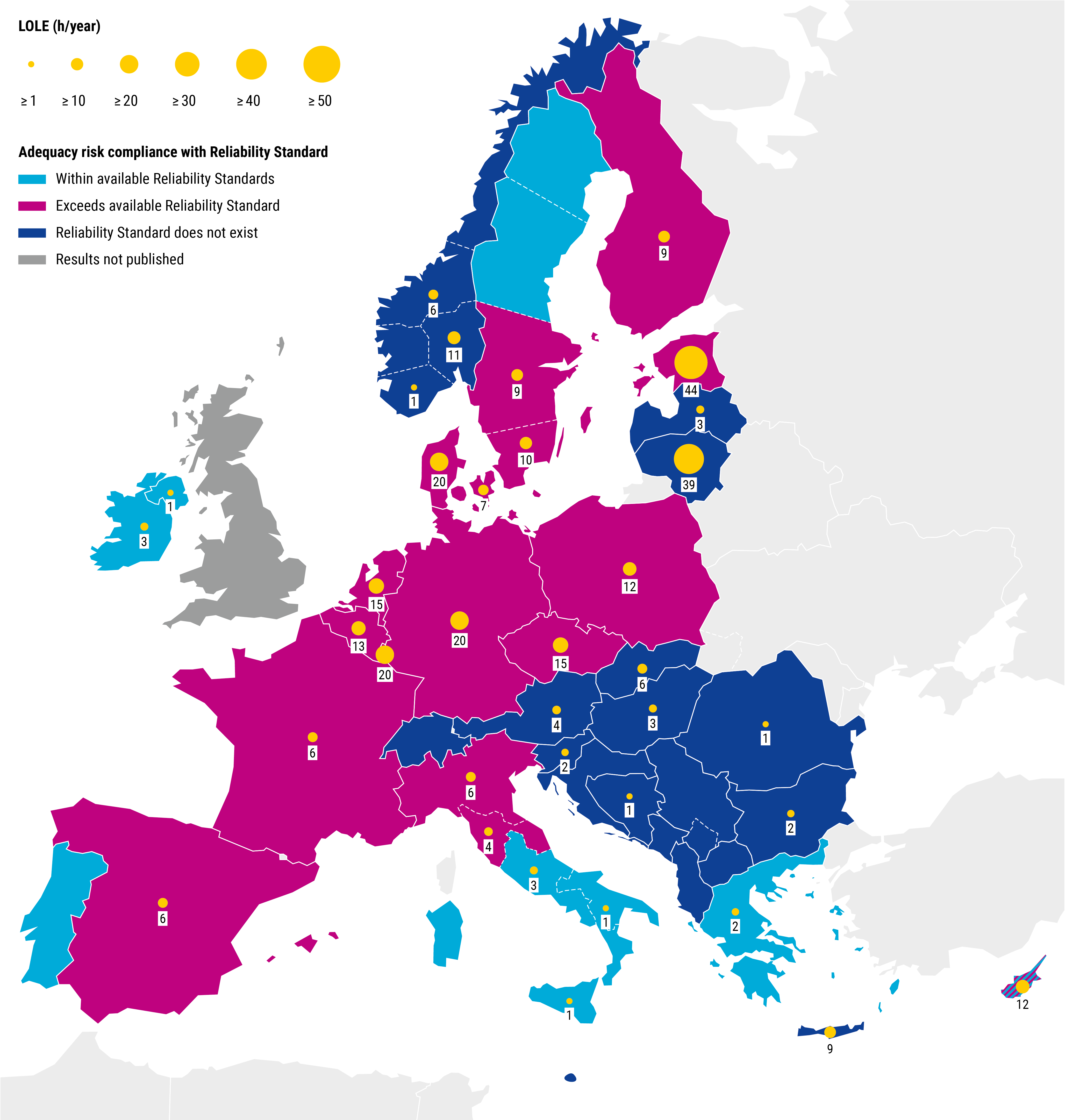
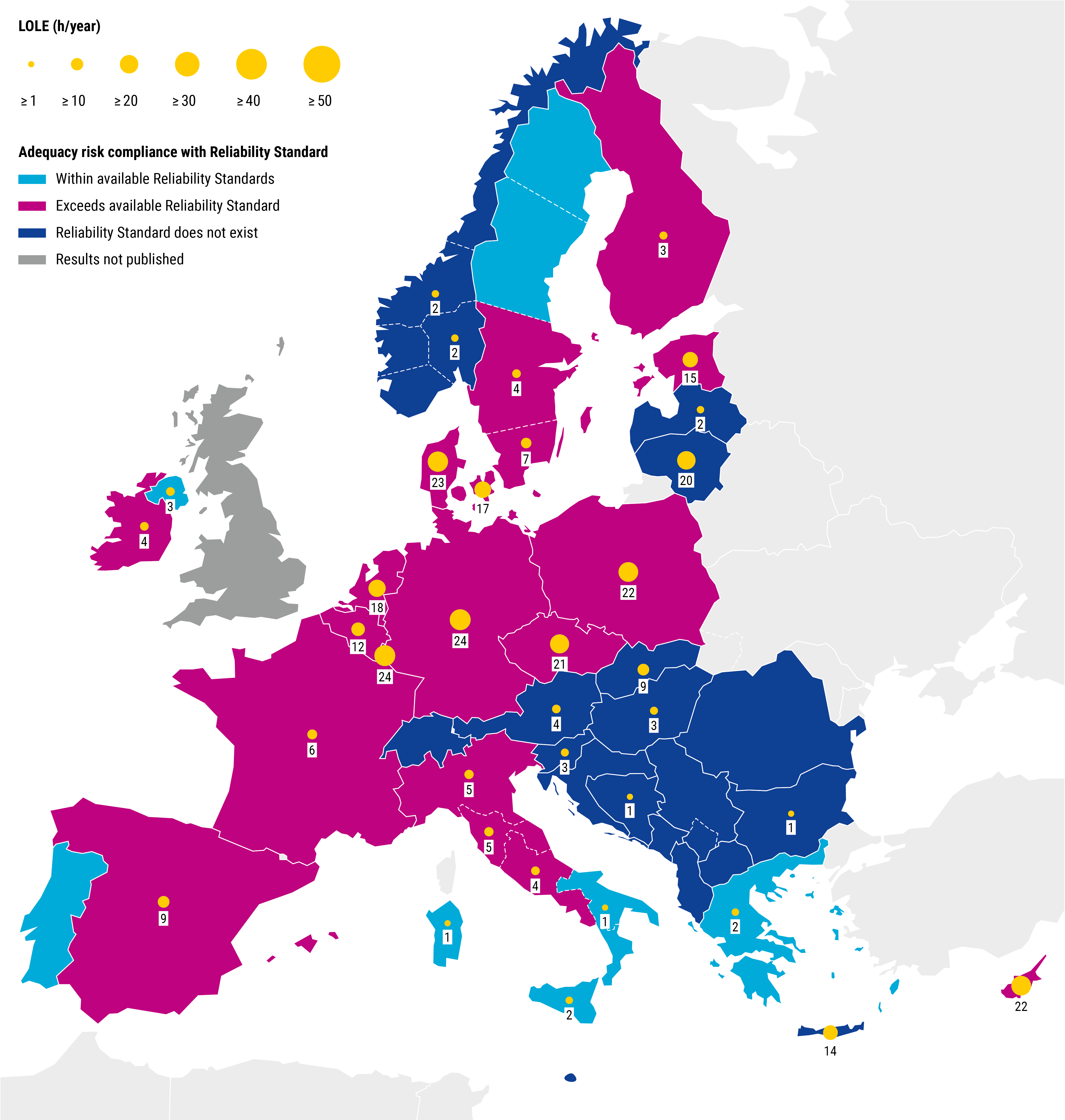
More detailed results, including Expected Energy Not Served (EENS) per region, can be found in Annex 3. For the methodology and probabilistic indicators, please see Annex 2. Moreover, there are cases where the results depend on the specific characteristics of each country or study zone. Annex 6 provides country-specific comments that enable more detailed conclusions.
Further remarks on result interpretation
Being an inherently complex study, ERAA 2025 is characterised by a high degree of uncertainty and significant computational constraints. Consequently, the modelling decisions and assumptions, as well as the probabilistic nature of the assessment, must be carefully considered when interpreting the results.
ERAA 2025 introduces impactful methodological enhancements compared to previous editions, notably in the modelling of investor risk aversion in the EVA and in the selection of representative weather scenarios. At the same time, assumptions for a given target year can change rapidly from one edition to the next due to the accelerating energy transition and the continuous update of policy and system data (e.g. revised NECPs). Comparisons between ERAA 2025 and earlier editions should therefore be made with caution, taking into account both input data updates and scenario changes, as well as methodological improvements that can materially affect adequacy outcomes.